Gallery
Iterate Elements
<%@ Page Language="C#" Description="dotnetCHARTING Component" %>
<%@ Register TagPrefix="dotnet" Namespace="dotnetCHARTING" Assembly="dotnetCHARTING"%>
<%@ Import Namespace="System.Drawing" %>
<script runat="server">
SeriesCollection getRandomData()
{
SeriesCollection SC = new SeriesCollection();
Random myR = new Random();
for(int a = 1; a < 5; a++)
{
Series s = new Series();
s.Name = "Series " + a;
for(int b = 1; b < 5; b++)
{
Element e = new Element();
e.Name = "Element " + b;
e.YValue = myR.Next(50);
s.Elements.Add(e);
}
SC.Add(s);
}
return SC;
}
void Page_Load(Object sender,EventArgs e)
{
Chart.Type = ChartType.Combo;//Horizontal;
Chart.Width = 600;
Chart.Height = 350;
Chart.TempDirectory = "temp";
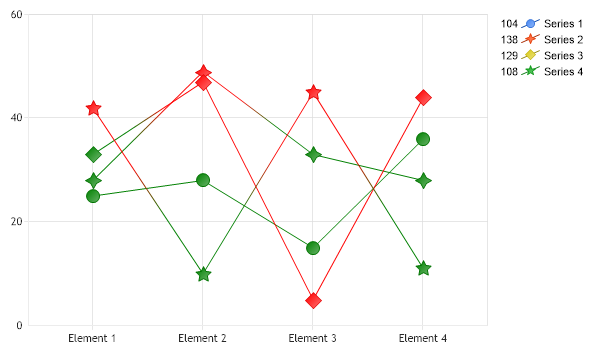
// Demonstrates how you can iterate through elements and change their color
// based on the data.
// We'll set the default type to line so it can be viewed better.
Chart.DefaultSeries.Type = SeriesType.Line;
// We'll also make the markers bigger so they can be seen better.
Chart.DefaultSeries.DefaultElement.Marker.Size = 13;
// First we get our data, if you would like to get the data from a database you need to use
// the data engine. See sample: features/dataEngine.aspx.
SeriesCollection sc = getRandomData();
// The elements values are between 0 and 50 so we'll make any elements outside on 10 to 40 red and within green.
foreach(Series s in sc)
foreach(Element el in s.Elements)
if(el.YValue < 10 || el.YValue > 40)
el.Color = Color.Red;
else
el.Color = Color.Green;
// Add the random data.
Chart.SeriesCollection.Add(sc);
}
</script>
<html xmlns="http://www.w3.org/1999/xhtml">
<head>
<title>Interate Elements</title>
</head>
<body>
<div style="text-align:center">
<dotnet:Chart id="Chart" runat="server"/>
</div>
</body>
</html>
<%@ Page Language="vb" Description="dotnetCHARTING Component" %>
<%@ Register TagPrefix="dotnet" Namespace="dotnetCHARTING" Assembly="dotnetCHARTING"%>
<%@ Import Namespace="System.Drawing" %>
<script runat="server">
Function getRandomData() As SeriesCollection
Dim SC As SeriesCollection = New SeriesCollection()
Dim myR As Random = New Random()
For a As Integer = 1 To 4
Dim s As Series = New Series()
s.Name = "Series " & a
For b As Integer = 1 To 4
Dim e As Element = New Element()
e.Name = "Element " & b
e.YValue = myR.Next(50)
s.Elements.Add(e)
Next b
SC.Add(s)
Next a
Return SC
End Function
Sub Page_Load(ByVal sender As Object, ByVal e As EventArgs)
Chart.Type = ChartType.Combo 'Horizontal;
Chart.Width = 600
Chart.Height = 350
Chart.TempDirectory = "temp"
' Demonstrates how you can iterate through elements and change their color
' based on the data.
' We'll set the default type to line so it can be viewed better.
Chart.DefaultSeries.Type = SeriesType.Line
' We'll also make the markers bigger so they can be seen better.
Chart.DefaultSeries.DefaultElement.Marker.Size = 13
' First we get our data, if you would like to get the data from a database you need to use
' the data engine. See sample: features/dataEngine.aspx.
Dim sc As SeriesCollection = getRandomData()
' The elements values are between 0 and 50 so we'll make any elements outside on 10 to 40 red and within green.
For Each s As Series In sc
For Each el As Element In s.Elements
If el.YValue < 10 OrElse el.YValue > 40 Then
el.Color = Color.Red
Else
el.Color = Color.Green
End If
Next el
Next s
' Add the random data.
Chart.SeriesCollection.Add(sc)
End Sub
</script>
<html xmlns="http://www.w3.org/1999/xhtml">
<head>
<title>Interate Elements</title>
</head>
<body>
<div style="text-align:center">
<dotnet:Chart id="Chart" runat="server"/>
</div>
</body>
</html>
- Sample FilenameIterateElements.aspx
- VersionLegacy (Pre 3.0)
- Uses DatabaseNo