Gallery
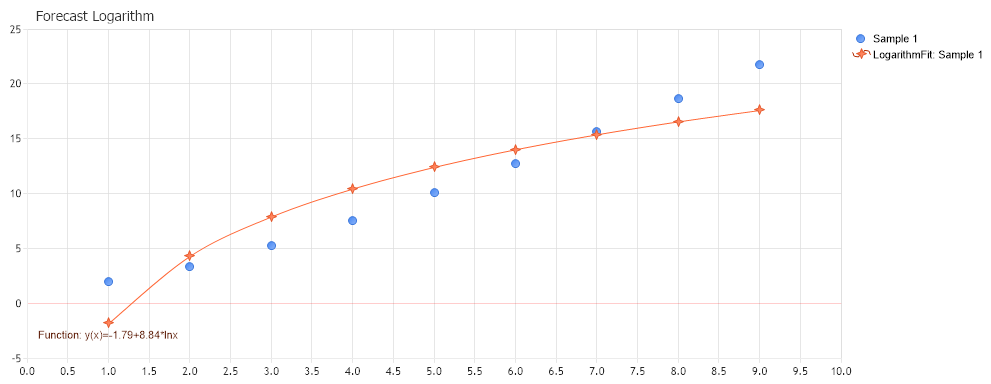
Trend Line Logarithmic
<%@ Page Language="C#" Description="dotnetCHARTING Component" %>
<%@ Register TagPrefix="dotnet" Namespace="dotnetCHARTING" Assembly="dotnetCHARTING"%>
<%@ Import Namespace="System.Drawing" %>
<%@ Import Namespace="System.Drawing.Drawing2D" %>
<%@ Import Namespace="dotnetCHARTING"%>
<html xmlns="http://www.w3.org/1999/xhtml">
<head>
<title>.netCHARTING Logarithm Sample</title>
<script runat="server">
void Page_Load(Object sender,EventArgs e)
{
// Demonstrates the use of TrendLineLogarithmic from within Forecasting
//which find the best fitting logarithmical curve to sets of data
// The Forecast Chart
ForecastChart.Title="Forecast Logarithm";
ForecastChart.TempDirectory="temp";
ForecastChart.Debug=true;
ForecastChart.Size = "1000x400";
ForecastChart.LegendBox.Template ="%icon %name";
ForecastChart.XAxis.Scale = Scale.Normal;
SeriesCollection slogarithm = new SeriesCollection();
Series sampledata1 = new Series ("Sample 1");
for ( int i = 1; i < 10; i++) {
Element el = new Element();
el.YValue = Math.Log(i)* i + 2;
el.XValue = i ;
sampledata1.Elements.Add (el);
}
slogarithm.Add (sampledata1);
slogarithm[0].Type = SeriesType.Marker;
ForecastChart.SeriesCollection.Add (slogarithm);
// Here we create a series which will hold the Y values calculated with the LogarithmFit indicator
Series trendLineLogarithmic = new Series();
trendLineLogarithmic = ForecastEngine.TrendLineLogarithmic(sampledata1);
//The next two lines display on to the chart the logarithmic function used
// to fit the curve
trendLineLogarithmic.Elements[0].SmartLabel.Text = "Function: %Function";
trendLineLogarithmic.Elements[0].ShowValue = true;
trendLineLogarithmic.DefaultElement.Color = Color.FromArgb(255,99,49);
trendLineLogarithmic.Type = SeriesType.Spline;
ForecastChart.SeriesCollection.Add(trendLineLogarithmic);
}
</script>
</head>
<body>
<div style="text-align:center">
<dotnet:Chart id="ForecastChart" runat="server"/>
</div>
</body>
</html>
<%@ Page Language="vb" Description="dotnetCHARTING Component" %>
<%@ Register TagPrefix="dotnet" Namespace="dotnetCHARTING" Assembly="dotnetCHARTING"%>
<%@ Import Namespace="System.Drawing" %>
<%@ Import Namespace="System.Drawing.Drawing2D" %>
<%@ Import Namespace="dotnetCHARTING"%>
<html xmlns="http://www.w3.org/1999/xhtml">
<head>
<title>.netCHARTING Logarithm Sample</title>
<script runat="server">
Sub Page_Load(ByVal sender As Object, ByVal e As EventArgs)
' Demonstrates the use of TrendLineLogarithmic from within Forecasting
'which find the best fitting logarithmical curve to sets of data
' The Forecast Chart
ForecastChart.Title="Forecast Logarithm"
ForecastChart.TempDirectory="temp"
ForecastChart.Debug=True
ForecastChart.Size = "1000x400"
ForecastChart.LegendBox.Template ="%icon %name"
ForecastChart.XAxis.Scale = Scale.Normal
Dim slogarithm As SeriesCollection = New SeriesCollection()
Dim sampledata1 As Series = New Series ("Sample 1")
For i As Integer = 1 To 9
Dim el As Element = New Element()
el.YValue = Math.Log(i)* i + 2
el.XValue = i
sampledata1.Elements.Add (el)
Next i
slogarithm.Add (sampledata1)
slogarithm(0).Type = SeriesType.Marker
ForecastChart.SeriesCollection.Add (slogarithm)
' Here we create a series which will hold the Y values calculated with the LogarithmFit indicator
Dim trendLineLogarithmic As Series = New Series()
trendLineLogarithmic = ForecastEngine.TrendLineLogarithmic(sampledata1)
'The next two lines display on to the chart the logarithmic function used
' to fit the curve
trendLineLogarithmic.Elements(0).SmartLabel.Text = "Function: %Function"
trendLineLogarithmic.Elements(0).ShowValue = True
trendLineLogarithmic.DefaultElement.Color = Color.FromArgb(255,99,49)
trendLineLogarithmic.Type = SeriesType.Spline
ForecastChart.SeriesCollection.Add(trendLineLogarithmic)
End Sub
</script>
</head>
<body>
<div style="text-align:center">
<dotnet:Chart id="ForecastChart" runat="server"/>
</div>
</body>
</html>
- Sample FilenameTrendLineLogarithmic.aspx
- VersionLegacy (Pre 3.0)
- Uses DatabaseNo