Gallery

 Previous
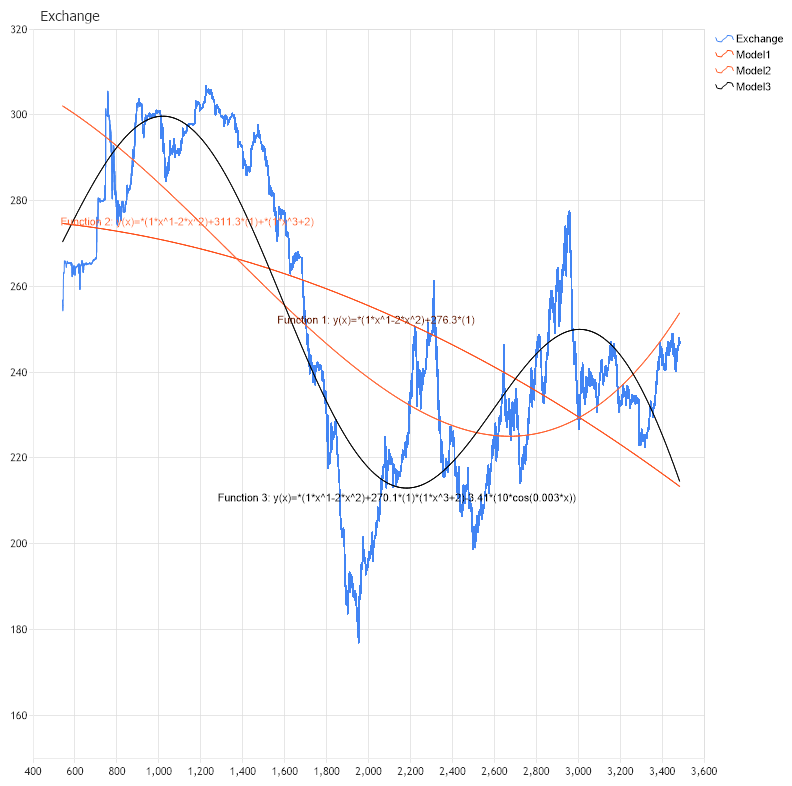
General Linear Fit
<%@ Page Language="C#" Description="dotnetCHARTING Component" %>
<%@ Register TagPrefix="dotnet" Namespace="dotnetCHARTING" Assembly="dotnetCHARTING"%>
<%@ Import Namespace="System.Drawing" %>
<%@ Import Namespace="System.Drawing.Drawing2D" %>
<%@ Import Namespace="dotnetCHARTING"%>
<html xmlns="http://www.w3.org/1999/xhtml">
<head>
<title>.netCHARTING Forecasting Sample</title>
<script runat="server">
void Page_Load(Object sender,EventArgs e)
{
// Demonstrates the use of GeneralLinear Forecasting engine in order to
// find the function of best fit from three functions spaces. The data used for which
// the functions are fit is a set of data which represents a FX exchange rate over a given
// period of time. We index the period by the number of days after the inital date and the
// three function spaces are the spaces spanned by the following basis elements:
//
// 1) {(x - 2*x^2)
// 2) {(x - 2*x^2) (x^3 + 1)}
// 3) {(x - 2*x^2) (x^3 + 1), (10*cos(0.003*x))}
//
// The Forecast Chart
ForecastChart.Title="Exchange";
ForecastChart.TempDirectory="temp";
ForecastChart.Debug=true;
ForecastChart.Size = "800x800";
ForecastChart.LegendBox.Template ="%icon %name";
ForecastChart.YAxis.ScaleRange.ValueLow = 150;
ForecastChart.Type = ChartType.Scatter;
ForecastChart.XAxis.Minimum = 400;
ForecastChart.XAxis.Maximum = 3600;
ForecastChart.XAxis.Interval = 200;
// The Forecast data
DataEngine de = new DataEngine();
de.ConnectionString = ConfigurationManager.AppSettings["DNCConnectionString"];
de.DateGrouping = TimeInterval.Days;
de.StartDate = new DateTime(1973,3,10,0,0,0);
de.EndDate = new DateTime(1984,12,10,23,59,59);
de.SqlStatement= @"SELECT ID, Value AS q FROM Exchange WHERE Data >= #STARTDATE# AND Data <= #ENDDATE# ORDER BY Data ";
//Add a series
SeriesCollection scForecast = de.GetSeries ();
ForecastChart.SeriesCollection.Add (scForecast);
scForecast[0].Name = "Exchange";
scForecast[0].Type = SeriesType.Spline;
/*
* Takes off the marker off the line and spline series.
*/
ForecastChart.DefaultSeries.DefaultElement.Marker = new ElementMarker (ElementMarkerType.None);
ForecastChart.ChartAreaLayout.Mode = ChartAreaLayoutMode.Vertical;
// Generate a series of standard deviation for the given points
Series deviation = new Series();
for (int i = 0; i < scForecast[0].Elements.Count; i++ )
{
Element el = new Element();
el.XValue = scForecast[0].Elements[i].XValue;
el.YValue = 0.0000000001;
deviation.Elements.Add(el);
}
// Note that this line is necessary in order to clear the function basis set by previous
// example.
//
ForecastEngine.Options.Reset();
// Set the first model function
//
// The first basis element: (x - 2*x^2)
ForecastEngine.Options.AddSumOfPowerTerms(new double[]{1, -2}, new double[]{1, 2});
// The second basis element: (1)
ForecastEngine.Options.AddSumOfPowerTerms(new double[]{1}, new double[]{0});
// Generate a new series which will draw the best fit line according with the model function which we just set
Series generalLinearModel1 = new Series();
generalLinearModel1 = ForecastEngine.Advanced.GeneralLinear(scForecast[0], deviation);
generalLinearModel1.Name = "Model1";
generalLinearModel1.Type = SeriesType.Spline;
//The next three lines display no to the chart the given function used
// to fit the curve
generalLinearModel1.Elements[1500].SmartLabel.Text = "Function 1: %Function";
generalLinearModel1.Elements[1500].ShowValue = true;
ForecastChart.SeriesCollection.Add(generalLinearModel1);
// Set the second model function ; we add x^3 function to the basis functions
ForecastEngine.Options.AddSumOfPowerTerms(new double[]{1, 2}, new double[]{3, 0});
// Generate a new series which will draw the best fit line according with the model function which we just set
Series generalLinearModel2 = new Series();
generalLinearModel2 = ForecastEngine.Advanced.GeneralLinear(scForecast[0], deviation);
generalLinearModel2.Name = "Model2";
generalLinearModel2.DefaultElement.Color = Color.FromArgb(255, 99, 49);
generalLinearModel2.Type = SeriesType.Spline;
//The next three lines display no to the chart the given function used
// to fit the curve
generalLinearModel2.Elements[600].SmartLabel.Text = "Function 2: %Function";
generalLinearModel2.Elements[600].SmartLabel.Color = Color.FromArgb(255, 99, 49);
generalLinearModel2.Elements[600].ShowValue = true;
ForecastChart.SeriesCollection.Add(generalLinearModel2);
// Set the third model function ; we add 10*cos(0.003*x)function to the basis functions
ForecastEngine.Options.AddCosineSum(new double[]{10}, new double[]{0.003}, new double[]{0}, new double[]{1});
// Generate a new series which will draw the best fit line according with the model function which we just set
Series generalLinearModel3 = new Series();
generalLinearModel3 = ForecastEngine.Advanced.GeneralLinear(scForecast[0], deviation);
generalLinearModel3.Name = "Model3";
generalLinearModel3.DefaultElement.Color = Color.FromArgb(0, 0, 0);
generalLinearModel3.Type = SeriesType.Spline;
//The next three lines display no to the chart the given function used
// to fit the curve
generalLinearModel3.Elements[1600].SmartLabel.Text = "Function 3: %Function";
// The label will have the same color as the element which he represents
generalLinearModel3.Elements[1600].SmartLabel.Color = Color.FromArgb(0, 0, 0);
generalLinearModel3.Elements[1600].ShowValue = true;
ForecastChart.SeriesCollection.Add(generalLinearModel3);
}
</script>
</head>
<body>
<div style="text-align:center">
<dotnet:Chart id="ForecastChart" runat="server"/>
</div>
</body>
</html>
<%@ Page Language="vb" Description="dotnetCHARTING Component" %>
<%@ Register TagPrefix="dotnet" Namespace="dotnetCHARTING" Assembly="dotnetCHARTING"%>
<%@ Import Namespace="System.Drawing" %>
<%@ Import Namespace="System.Drawing.Drawing2D" %>
<%@ Import Namespace="dotnetCHARTING"%>
<html xmlns="http://www.w3.org/1999/xhtml">
<head>
<title>.netCHARTING Forecasting Sample</title>
<script runat="server">
Sub Page_Load(ByVal sender As Object, ByVal e As EventArgs)
' Demonstrates the use of GeneralLinear Forecasting engine in order to
' find the function of best fit from three functions spaces. The data used for which
' the functions are fit is a set of data which represents a FX exchange rate over a given
' period of time. We index the period by the number of days after the inital date and the
' three function spaces are the spaces spanned by the following basis elements:
'
' 1) {(x - 2*x^2)
' 2) {(x - 2*x^2) (x^3 + 1)}
' 3) {(x - 2*x^2) (x^3 + 1), (10*cos(0.003*x))}
'
' The Forecast Chart
ForecastChart.Title="Exchange"
ForecastChart.TempDirectory="temp"
ForecastChart.Debug=True
ForecastChart.Size = "800x800"
ForecastChart.LegendBox.Template ="%icon %name"
ForecastChart.YAxis.ScaleRange.ValueLow = 150
ForecastChart.Type = ChartType.Scatter
ForecastChart.XAxis.Minimum = 400
ForecastChart.XAxis.Maximum = 3600
ForecastChart.XAxis.Interval = 200
' The Forecast data
Dim de As DataEngine = New DataEngine()
de.ConnectionString = ConfigurationManager.AppSettings("DNCConnectionString")
de.DateGrouping = TimeInterval.Days
de.StartDate = New DateTime(1973,3,10,0,0,0)
de.EndDate = New DateTime(1984,12,10,23,59,59)
de.SqlStatement= "SELECT ID, Value AS q FROM Exchange WHERE Data >= #STARTDATE# AND Data <= #ENDDATE# ORDER BY Data "
'Add a series
Dim scForecast As SeriesCollection = de.GetSeries ()
ForecastChart.SeriesCollection.Add (scForecast)
scForecast(0).Name = "Exchange"
scForecast(0).Type = SeriesType.Spline
'
'* Takes off the marker off the line and spline series.
'
ForecastChart.DefaultSeries.DefaultElement.Marker = New ElementMarker (ElementMarkerType.None)
ForecastChart.ChartAreaLayout.Mode = ChartAreaLayoutMode.Vertical
' Generate a series of standard deviation for the given points
Dim deviation As Series = New Series()
For i As Integer = 0 To scForecast(0).Elements.Count - 1
Dim el As Element = New Element()
el.XValue = scForecast(0).Elements(i).XValue
el.YValue = 0.0000000001
deviation.Elements.Add(el)
Next i
' Note that this line is necessary in order to clear the function basis set by previous
' example.
'
ForecastEngine.Options.Reset()
' Set the first model function
'
' The first basis element: (x - 2*x^2)
ForecastEngine.Options.AddSumOfPowerTerms(New Double(){1, -2}, New Double(){1, 2})
' The second basis element: (1)
ForecastEngine.Options.AddSumOfPowerTerms(New Double(){1}, New Double(){0})
' Generate a new series which will draw the best fit line according with the model function which we just set
Dim generalLinearModel1 As Series = New Series()
generalLinearModel1 = ForecastEngine.Advanced.GeneralLinear(scForecast(0), deviation)
generalLinearModel1.Name = "Model1"
generalLinearModel1.Type = SeriesType.Spline
'The next three lines display no to the chart the given function used
' to fit the curve
generalLinearModel1.Elements(1500).SmartLabel.Text = "Function 1: %Function"
generalLinearModel1.Elements(1500).ShowValue = True
ForecastChart.SeriesCollection.Add(generalLinearModel1)
' Set the second model function ; we add x^3 function to the basis functions
ForecastEngine.Options.AddSumOfPowerTerms(New Double(){1, 2}, New Double(){3, 0})
' Generate a new series which will draw the best fit line according with the model function which we just set
Dim generalLinearModel2 As Series = New Series()
generalLinearModel2 = ForecastEngine.Advanced.GeneralLinear(scForecast(0), deviation)
generalLinearModel2.Name = "Model2"
generalLinearModel2.DefaultElement.Color = Color.FromArgb(255, 99, 49)
generalLinearModel2.Type = SeriesType.Spline
'The next three lines display no to the chart the given function used
' to fit the curve
generalLinearModel2.Elements(600).SmartLabel.Text = "Function 2: %Function"
generalLinearModel2.Elements(600).SmartLabel.Color = Color.FromArgb(255, 99, 49)
generalLinearModel2.Elements(600).ShowValue = True
ForecastChart.SeriesCollection.Add(generalLinearModel2)
' Set the third model function ; we add 10*cos(0.003*x)function to the basis functions
ForecastEngine.Options.AddCosineSum(New Double(){10}, New Double(){0.003}, New Double(){0}, New Double(){1})
' Generate a new series which will draw the best fit line according with the model function which we just set
Dim generalLinearModel3 As Series = New Series()
generalLinearModel3 = ForecastEngine.Advanced.GeneralLinear(scForecast(0), deviation)
generalLinearModel3.Name = "Model3"
generalLinearModel3.DefaultElement.Color = Color.FromArgb(0, 0, 0)
generalLinearModel3.Type = SeriesType.Spline
'The next three lines display no to the chart the given function used
' to fit the curve
generalLinearModel3.Elements(1600).SmartLabel.Text = "Function 3: %Function"
' The label will have the same color as the element which he represents
generalLinearModel3.Elements(1600).SmartLabel.Color = Color.FromArgb(0, 0, 0)
generalLinearModel3.Elements(1600).ShowValue = True
ForecastChart.SeriesCollection.Add(generalLinearModel3)
End Sub
</script>
</head>
<body>
<div style="text-align:center">
<dotnet:Chart id="ForecastChart" runat="server"/>
</div>
</body>
</html>
- Sample FilenameGeneralLinearFit.aspx
- VersionLegacy (Pre 3.0)
- Uses DatabaseYes