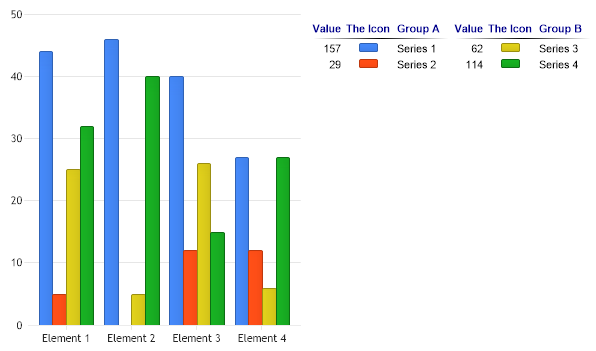
// *DYNAMIC DATA NOTE* // This sample uses random data to populate the chart. To populate // a chart with database data see the following resources: // - Classic samples folder // - Help File > Data Tutorials // - Sample: features/DataEngine.aspx SeriesCollection mySC = getRandomData();
// Instantiate a legend entry to be our first header. LegendEntry header1 = new LegendEntry("Group A","Value","The Icon"); // Notice we used a constructor that takes a string for the icon. This can also be done by adding an attribute with // a 'icon' key' like so: header1.CustomAttributes = "Icon=The Icon";
// Now we'll instantiate our second header entry. LegendEntry header2 = new LegendEntry("Group B","Value","The Icon"); header2.CustomAttributes = "Icon=The Icon"; // We'll add some additional padding at the top of each header. header1.PaddingTop = 5; header2.PaddingTop = 5;
// Specify a divider line color. header1.DividerLine.Color = Color.Black; header2.DividerLine.Color = Color.Black;
// Set a different font and color for the headers. header1.LabelStyle.Font = new Font("Arial",8,FontStyle.Bold); header2.LabelStyle.Font = new Font("Arial",8,FontStyle.Bold); header1.LabelStyle.Color = Color.DarkBlue; header2.LabelStyle.Color = Color.DarkBlue;
// This will demonstrate how a header can start a new column. header2.HeaderMode = LegendEntryHeaderMode.StartNewColumn;
// We have our headers but since they are normal legend entries we must ensure they are placed before // the series they represent. Each legend entry sort order is by default 0 so for the first entry // we set the sort order to -1. Then series mySC[0] and mySC[1] will follow. header1.SortOrder = -1; // Now the second entry order we'll set to 1 so if follows the first group and set the sort order of the series // it represents to 2. header2.SortOrder = 1; mySC[2].LegendEntry.SortOrder = 2; mySC[3].LegendEntry.SortOrder = 2;
//Finally we add the header entries to our box. Chart.LegendBox.ExtraEntries.Add(header1); Chart.LegendBox.ExtraEntries.Add(header2);
// Add the random data. Chart.SeriesCollection.Add(mySC);
}
SeriesCollection getRandomData() { SeriesCollection SC = new SeriesCollection(); Random myR = new Random(); for(int a = 1; a < 5; a++) { Series s = new Series(); s.Name = "Series " + a; for(int b = 1; b < 5; b++) { Element e = new Element(); e.Name = "Element " + b; //e.YValue = -25 + myR.Next(50); e.YValue = myR.Next(50); s.Elements.Add(e); } SC.Add(s); }
' *DYNAMIC DATA NOTE* ' This sample uses random data to populate the chart. To populate ' a chart with database data see the following resources: ' - Classic samples folder ' - Help File > Data Tutorials ' - Sample: features/DataEngine.aspx Dim mySC As SeriesCollection = getRandomData()
' Instantiate a legend entry to be our first header. Dim header1 As LegendEntry = New LegendEntry("Group A","Value","The Icon") ' Notice we used a constructor that takes a string for the icon. This can also be done by adding an attribute with ' a 'icon' key' like so: header1.CustomAttributes = "Icon=The Icon"
' Now we'll instantiate our second header entry. Dim header2 As LegendEntry = New LegendEntry("Group B","Value","The Icon") header2.CustomAttributes = "Icon=The Icon" ' We'll add some additional padding at the top of each header. header1.PaddingTop = 5 header2.PaddingTop = 5
' Specify a divider line color. header1.DividerLine.Color = Color.Black header2.DividerLine.Color = Color.Black
' Set a different font and color for the headers. header1.LabelStyle.Font = New Font("Arial",8,FontStyle.Bold) header2.LabelStyle.Font = New Font("Arial",8,FontStyle.Bold) header1.LabelStyle.Color = Color.DarkBlue header2.LabelStyle.Color = Color.DarkBlue
' This will demonstrate how a header can start a new column. header2.HeaderMode = LegendEntryHeaderMode.StartNewColumn
' We have our headers but since they are normal legend entries we must ensure they are placed before ' the series they represent. Each legend entry sort order is by default 0 so for the first entry ' we set the sort order to -1. Then series mySC[0] and mySC[1] will follow. header1.SortOrder = -1 ' Now the second entry order we'll set to 1 so if follows the first group and set the sort order of the series ' it represents to 2. header2.SortOrder = 1 mySC(2).LegendEntry.SortOrder = 2 mySC(3).LegendEntry.SortOrder = 2
'Finally we add the header entries to our box. Chart.LegendBox.ExtraEntries.Add(header1) Chart.LegendBox.ExtraEntries.Add(header2)
' Add the random data. Chart.SeriesCollection.Add(mySC)
End Sub
Function getRandomData() As SeriesCollection Dim SC As SeriesCollection = New SeriesCollection() Dim myR As Random = New Random() For a As Integer = 1 To 4 Dim s As Series = New Series() s.Name = "Series " & a For b As Integer = 1 To 4 Dim e As Element = New Element() e.Name = "Element " & b 'e.YValue = -25 + myR.Next(50); e.YValue = myR.Next(50) s.Elements.Add(e) Next b SC.Add(s) Next a
Return SC End Function </script> </head> <body> <div style="text-align:center"> <dotnet:Chart id="Chart" runat="server" Width="568px" Height="344px"> </dotnet:Chart> </div> </body> </html>

 Previous