Gallery
Image Bar One To One 4
<%@ Page Language="C#" Description="dotnetCHARTING Component" %>
<%@ Register TagPrefix="dotnet" Namespace="dotnetCHARTING" Assembly="dotnetCHARTING" %>
<%@ Import Namespace="System.Drawing" %>
<%@ Import Namespace="System.Drawing.Drawing2D" %>
<%@ Import Namespace="dotnetCHARTING.Mapping" %>
<script runat="server">
void Page_Load(Object sender, EventArgs e)
{
// Demonstrates using the ImageBarSyncToValue feature where the image bars repeat the same number of times as represented by the element's value.
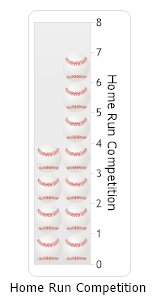
Chart.TempDirectory = "temp";
Chart.Debug = true;
Chart.DefaultSeries.Palette = new Color[] { Color.FromArgb(255, 99, 49), Color.FromArgb(0, 156, 255) };
Chart.LegendBox.Visible = false;
Chart.Size = "200x300";
Chart.Type = ChartType.Gauges;
Chart.DefaultSeries.GaugeType = GaugeType.Vertical;
Chart.ShadingEffectMode = ShadingEffectMode.Three;
Chart.ChartArea.ClearColors();
Chart.DefaultSeries.ImageBarSyncToValue = true;
Chart.DefaultSeries.GaugeBorderBox.DefaultCorner = BoxCorner.Round;
Chart.DefaultSeries.GaugeBorderShape = GaugeBorderShape.UseBox;
Chart.DefaultSeries.GaugeBorderBox.Padding = 6;
Chart.YAxis.Label.Text = "Home Run Competition";
Chart.YAxis.TickLabelPadding = 2;
Chart.YAxis.Orientation = dotnetCHARTING.Orientation.Right;
Chart.YAxis.Maximum = 8;
Chart.YAxis.Interval = 1;
// *DYNAMIC DATA NOTE*
// This sample uses random data to populate the chart. To populate
// a chart with database data see the following resources:
// - Help File > Getting Started > Data Tutorials
// - DataEngine Class in the help file
// - Sample: features/DataEngine.aspx
SeriesCollection mySC = getRandomData();
mySC[0].ImageBarTemplate = "../../images/ImageBarTemplates/baseball";
// Add the random data.
Chart.SeriesCollection.Add(mySC);
}
SeriesCollection getRandomData()
{
Random myR = new Random();
SeriesCollection SC = new SeriesCollection();
int a = 0;
int b = 0;
for (a = 1; a < 2; a++)
{
Series s = new Series("Jay Vs Bill");
for (b = 1; b < 3; b++)
{
Element e = new Element("Team " + b.ToString());
e.YValue = 1 + myR.Next(7);
s.Elements.Add(e);
}
SC.Add(s);
}
return SC;
}
SeriesCollection getLiveData()
{
DataEngine de = new DataEngine("ConnectionString goes here");
de.ChartObject = Chart; // Necessary to view any errors the dataEngine may throw.
de.SqlStatement = "SELECT XAxisColumn, YAxisColumn FROM ....";
return de.GetSeries();
}
</script>
<html xmlns="http://www.w3.org/1999/xhtml">
<head>
<title>.netCHARTING Sample</title>
</head>
<body>
<div align="center">
<dotnet:Chart ID="Chart" runat="server" />
</div>
</body>
</html>
<%@ Page Language="vb" Description="dotnetCHARTING Component" %>
<%@ Register TagPrefix="dotnet" Namespace="dotnetCHARTING" Assembly="dotnetCHARTING" %>
<%@ Import Namespace="System.Drawing" %>
<%@ Import Namespace="System.Drawing.Drawing2D" %>
<%@ Import Namespace="dotnetCHARTING.Mapping" %>
<script runat="server">
Sub Page_Load(ByVal sender As Object, ByVal e As EventArgs)
' Demonstrates using the ImageBarSyncToValue feature where the image bars repeat the same number of times as represented by the element's value.
Chart.TempDirectory = "temp"
Chart.Debug = True
Chart.DefaultSeries.Palette = New Color() { Color.FromArgb(255, 99, 49), Color.FromArgb(0, 156, 255) }
Chart.LegendBox.Visible = False
Chart.Size = "200x300"
Chart.Type = ChartType.Gauges
Chart.DefaultSeries.GaugeType = GaugeType.Vertical
Chart.ShadingEffectMode = ShadingEffectMode.Three
Chart.ChartArea.ClearColors()
Chart.DefaultSeries.ImageBarSyncToValue = True
Chart.DefaultSeries.GaugeBorderBox.DefaultCorner = BoxCorner.Round
Chart.DefaultSeries.GaugeBorderShape = GaugeBorderShape.UseBox
Chart.DefaultSeries.GaugeBorderBox.Padding = 6
Chart.YAxis.Label.Text = "Home Run Competition"
Chart.YAxis.TickLabelPadding = 2
Chart.YAxis.Orientation = dotnetCHARTING.Orientation.Right
Chart.YAxis.Maximum = 8
Chart.YAxis.Interval = 1
' *DYNAMIC DATA NOTE*
' This sample uses random data to populate the chart. To populate
' a chart with database data see the following resources:
' - Help File > Getting Started > Data Tutorials
' - DataEngine Class in the help file
' - Sample: features/DataEngine.aspx
Dim mySC As SeriesCollection = getRandomData()
mySC(0).ImageBarTemplate = "../../images/ImageBarTemplates/baseball"
' Add the random data.
Chart.SeriesCollection.Add(mySC)
End Sub
Function getRandomData() As SeriesCollection
Dim myR As Random = New Random()
Dim SC As SeriesCollection = New SeriesCollection()
Dim a As Integer = 0
Dim b As Integer = 0
For a = 1 To 1
Dim s As Series = New Series("Jay Vs Bill")
For b = 1 To 2
Dim e As Element = New Element("Team " & b.ToString())
e.YValue = 1 + myR.Next(7)
s.Elements.Add(e)
Next b
SC.Add(s)
Next a
Return SC
End Function
Function getLiveData() As SeriesCollection
Dim de As DataEngine = New DataEngine("ConnectionString goes here")
de.ChartObject = Chart ' Necessary to view any errors the dataEngine may throw.
de.SqlStatement = "SELECT XAxisColumn, YAxisColumn FROM ...."
Return de.GetSeries()
End Function
</script>
<html xmlns="http://www.w3.org/1999/xhtml">
<head>
<title>.netCHARTING Sample</title>
</head>
<body>
<div align="center">
<dotnet:Chart ID="Chart" runat="server" />
</div>
</body>
</html>
- Sample FilenameImageBarOneToOne4.aspx
- Version4.4
- Uses DatabaseNo