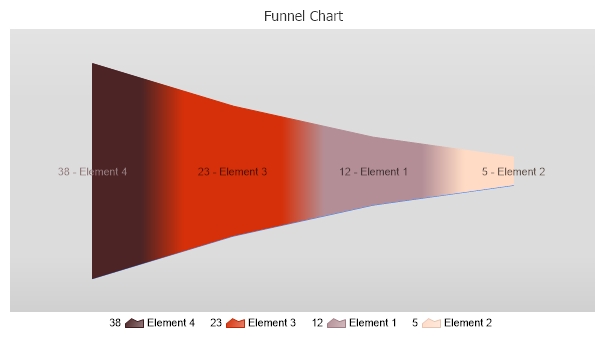
// *DYNAMIC DATA NOTE* // This sample uses random data to populate the chart. To populate // a chart with database data see the following resources: // - Classic samples folder // - Help File > Data Tutorials // - Sample: features/DataEngine.aspx Series mySeries = getRandomData()[0];
// First we sort the series mySeries.Sort(ElementValue.YValue,"DESC");
// Make it an area line and get rid of the element markers. mySeries.Type = SeriesType.AreaLine; mySeries.DefaultElement.Marker.Type = ElementMarkerType.None;
// Create funnel data createFunnel(mySeries);
// Five each element a new palette. mySeries.PaletteName = Palette.Lavender;
// Turn off all shadows. Chart.DefaultShadow.Color = Color.Empty;
// Add the random data. Chart.SeriesCollection.Add(mySeries);
} void createFunnel(Series s) { // This loop will set the same but negated y value start of the area line as it's value; foreach(Element myElement in s.Elements) { // Because this will double the values we divide it by two first. myElement.YValue /= 2; myElement.YValueStart = -myElement.YValue;
} }
SeriesCollection getRandomData() { SeriesCollection SC = new SeriesCollection(); Random myR = new Random(1); for(int a = 1; a < 5; a++) { Series s = new Series(); s.Name = "Series " + a; for(int b = 1; b < 5; b++) { Element e = new Element(); e.Name = "Element " + b; //e.YValue = -25 + myR.Next(50); e.YValue = myR.Next(50); s.Elements.Add(e); } SC.Add(s); } return SC; } </script> </head> <body> <div style="text-align:center"> <dotnet:Chart id="Chart" runat="server" Width="568px" Height="344px"> </dotnet:Chart> </div> </body> </html>
' *DYNAMIC DATA NOTE* ' This sample uses random data to populate the chart. To populate ' a chart with database data see the following resources: ' - Classic samples folder ' - Help File > Data Tutorials ' - Sample: features/DataEngine.aspx Dim mySeries As Series = getRandomData()(0)
' First we sort the series mySeries.Sort(ElementValue.YValue,"DESC")
' Make it an area line and get rid of the element markers. mySeries.Type = SeriesType.AreaLine mySeries.DefaultElement.Marker.Type = ElementMarkerType.None
' Create funnel data createFunnel(mySeries)
' Five each element a new palette. mySeries.PaletteName = Palette.Lavender
' Turn off all shadows. Chart.DefaultShadow.Color = Color.Empty
' Add the random data. Chart.SeriesCollection.Add(mySeries)
End Sub Sub createFunnel(ByVal s As Series) ' This loop will set the same but negated y value start of the area line as it's value; For Each myElement As Element In s.Elements ' Because this will double the values we divide it by two first. myElement.YValue /= 2 myElement.YValueStart = -myElement.YValue
Next myElement End Sub
Function getRandomData() As SeriesCollection Dim SC As SeriesCollection = New SeriesCollection() Dim myR As Random = New Random(1) For a As Integer = 1 To 4 Dim s As Series = New Series() s.Name = "Series " & a For b As Integer = 1 To 4 Dim e As Element = New Element() e.Name = "Element " & b 'e.YValue = -25 + myR.Next(50); e.YValue = myR.Next(50) s.Elements.Add(e) Next b SC.Add(s) Next a Return SC End Function </script> </head> <body> <div style="text-align:center"> <dotnet:Chart id="Chart" runat="server" Width="568px" Height="344px"> </dotnet:Chart> </div> </body> </html>

 Previous